For nearly two decades Sweden has been battling a mysterious illness. Called Resignation Syndrome, it affects only the children of asylum-seekers, who withdraw completely, ceasing to walk or talk, or open their eyes. Eventually they recover. But why does this only seem to occur in Sweden?
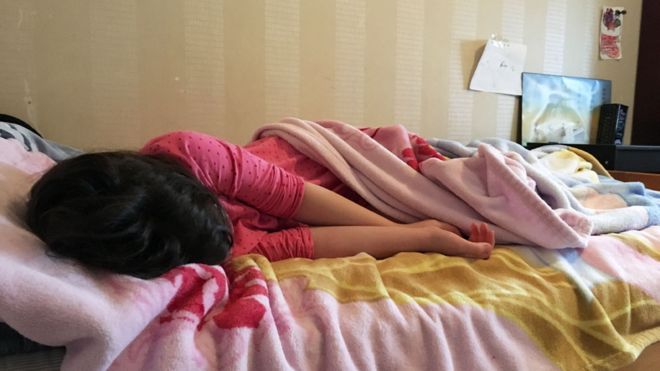
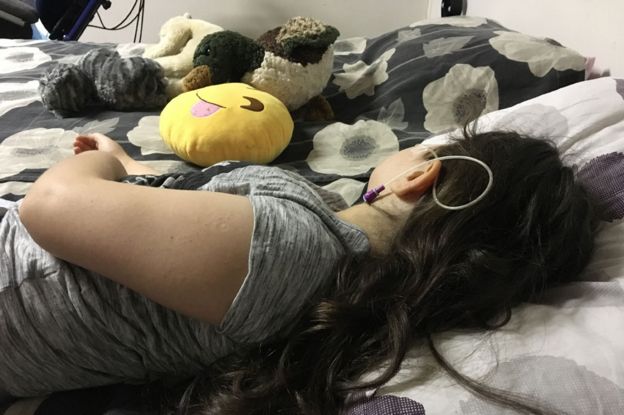
When her father picks her up from her wheelchair, nine-year-old Sophie is lifeless. In contrast, her hair is thick and shiny - like a healthy child's. But Sophie's eyes are closed. And under her tracksuit bottoms she wears a nappy. A transparent feeding tube runs into Sophie's nose - this is how she has been nourished for the past 20 months.
Sophie and her family are asylum seekers from the former USSR. They arrived in December 2015 and live in accommodation allocated to refugees in a small town in central Sweden.
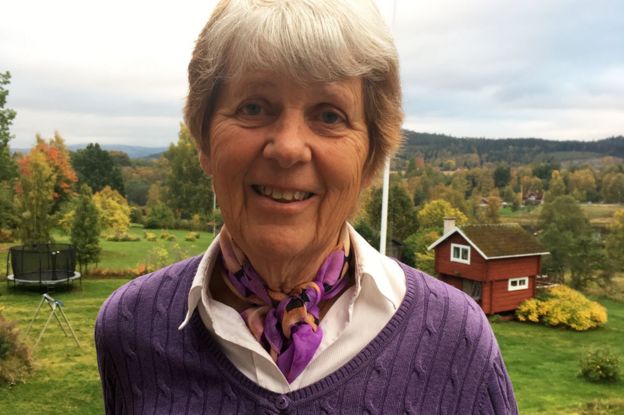
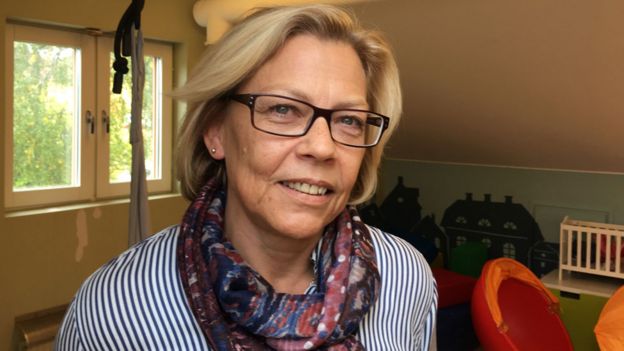
"Her blood pressure is quite normal," says Dr Elisabeth Hultcrantz, a volunteer with Doctors of the World. "But she has a high pulse rate, so maybe she's reacting to so many people coming to visit her today."
Hultcrantz tests Sophie's reflexes. Everything works normally. But the child does not stir.
An ENT surgeon before she retired, Hultcrantz is worried because Sophie does not ever open her mouth. This could be dangerous, because if there were a problem with her feeding tube, Sophie could choke.
Image captionElisabeth Hultcrantz: Children disconnect the conscious part of their brain
So how could a child who loved to dance become so deeply inert?
"When I explain to the parents what has happened, I tell them the world has been so terrible that Sophie has gone into herself and disconnected the conscious part of her brain," says Hultcrantz.
The health professionals who treat these children agree that trauma is what has caused them to withdraw from the world. The children who are most vulnerable are those who have witnessed extreme violence - often against their parents - or whose families have fled a deeply insecure environment.
Sophie's parents have a terrifying story of extortion and persecution by a local mafia. In September 2015 their car was stopped by men in police uniform.
"We were dragged out. Sophie was in the car so she witnessed me and her mother being roughly beaten," remembers Sophie's father.
The men let Sophie's mother go - she grabbed her daughter and ran. But Sophie's father did not escape.
"They took me away and then I don't remember anything," he says.
Sophie's mother took her to a friend's home. The little girl was very upset. She cried, shouted "Please go and find my dad!", and beat the wall with her feet.
Three days later, her father made contact, and from then on the family remained on the move, hiding in friends' homes until they left for Sweden three months later. On arrival, they were held for hours by Swedish police. Then, quite quickly, Sophie deteriorated.
"After a couple of days, I noticed she wasn't playing as much as she used to with her sister," says Sophie's mother, who is expecting a new baby next month.
Soon afterwards, the family was informed they could not stay in Sweden. Sophie heard everything in that meeting with the Migration Board, and it was at this point that she stopped speaking and eating.
Resignation Syndrome was first reported in Sweden in the late 1990s. More than 400 cases were reported in the two years from 2003-2005.
As more Swedes began to worry about the consequences of immigration, these "apathetic children", as they were known, became a huge political issue. There were reports the children were faking it, and that parents were poisoning their offspring to secure residence. None of those stories were proven.
Over the last decade, the number of children reported to be suffering from Resignation Syndrome has decreased. Sweden's National Board of Health recently stated there were 169 cases in 2015 and 2016.
It remains the case that children from particular geographical and ethnic groups are the most vulnerable: those from the former USSR, the Balkans, Roma children, and most recently the Yazidi. Only a tiny number have been unaccompanied migrants, none have been African, and very few have been Asian. Unlike Sophie, the children affected have often been living in Sweden for years, speak the language and are well-adjusted to their new, Nordic lives.
Numerous conditions resembling Resignation Syndrome have been reported before - among Nazi concentration camp inmates, for example. In the UK, a similar condition - Pervasive Refusal Syndrome - was identified in children in the early 1990s, but there have been only a tiny handful of cases, and none of them among asylum seekers.
"To our knowledge, no cases have been established outside of Sweden," writes Dr Karl Sallin, a paediatrician at the Astrid Lindgren Children's Hospital, part of Karolinska University Hospital in Stockholm.
Find out more
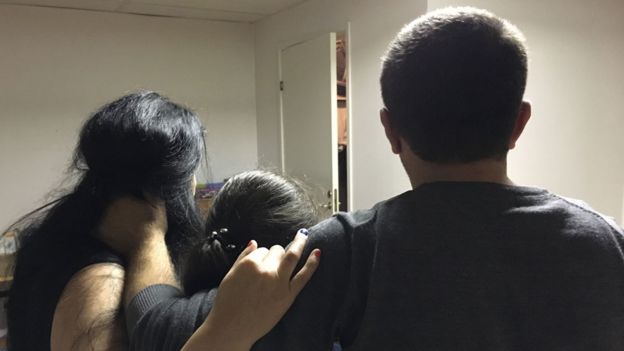
Image captionSophie's mother, sister and father
Listen to Sweden's Child Migrant Mystery on Assignment, on the BBC World Service
For transmission times or to catch up online, click here
So how can an illness respect national boundaries? There is no definitive answer to that question, says Sallin, who is researching Resignation Syndrome for his PhD.
"The most plausible explanation is that there are some sort of socio-cultural factors that are necessary in order for this condition to develop. A certain way of reacting or responding to traumatic events seems to be legitimised in a certain context."
So somehow - and we do not know the mechanism for this, and why it should happen in Sweden - the kind of symptoms displayed by the children are culturally sanctioned: this is a way the children are allowed to express their trauma. If that is the case, it raises an interesting question: could Resignation Syndrome be contagious?
"That is sort of implicit in the model. That if you provide the right sort of nourishment for those kinds of behaviours in a society, you will also see more cases," says Sallin.
"If you look at the very first case in 1998 in the north of Sweden, as soon as that case was reported, there were other cases emerging in the same area. And there have also been cases of siblings where first one develops it and then the other. But it should be noted that researchers who proposed that model of disease, they are not certain that there needs to be direct contact between cases. It's a topic for research."
Here Sallin hits on the main obstacle to understanding Resignation Syndrome - the lack of research into it. No-one has done follow-up on what happens to these children, but we do know that they survive.
For Sophie's parents, that is hard to believe. They have seen no change in their daughter in 20 months. Their days are punctuated by Sophie's regime - exercises to stop her muscles wasting, attempts to engage her with music and cartoons, walks outside in a wheelchair, feeding and changing.
"You need to harden your heart with these cases," says Sophie's paediatrician, Dr Lars Dagson, who has seen her regularly throughout her illness.
"I can only keep her alive. I can't make her better, because as doctors we don't decide if these children can stay in Sweden or not."
Image captionAnnica Carlshamre: This sickness has to do with trauma, not asylum
Dagson shares the view commonly held among doctors treating children with Resignation Syndrome, that recovery depends on them feeling secure and that it is a permanent residence permit that kick-starts that process.
"In some way the child will have to sense that there's hope, something to live for… That's the only way I can explain why having the right to stay would, in all the cases I've seen so far, change the situation."
Until recently, families with a sick child were allowed to stay. But the arrival of some 300,000 migrants in the last three years has led to a change of heart.
Last year, a new temporary law came into force that limits all asylum seekers' chances of being granted permanent residence. Applicants are granted either a three-year or 13-month visa. Sophie's family have the latter, and it expires in March next year.
"What happens afterwards? The real issue hasn't been dealt with - it's limbo," says Dagson.
He doubts Sophie will recover in 13 months.
"I can't say it's not possible, but it all depends how the parents sense this - are we going to stay after these 13 months? If they're not sure about that, they cannot give Sophie the sense that everything is OK."
But evidence from the town of Skara in the south of Sweden suggests that there is a way of curing children with Resignation Syndrome even if the family doesn't receive permanent residence.
"From our point of view, this particular sickness has to do with former trauma, not asylum," says Annica Carlshamre, a senior social worker for Gryning Health, a company that runs Solsidan, a home for all kinds of troubled children.
When children witness violence or threats against a parent, their most significant connection in the world is ripped apart, the carers at Solsidan believe.
"Then the child understands - my mother can't take care of me," Carlshamre explains. "And they give up hope, because they know they are totally dependent on the parent. When that happens, to where or what can the child turn?"
That family connection must be re-built, but first the child must begin to recover, so Solsidan's first step is to separate the children from their parents.
"We keep the family informed about their progress, but we don't let them talk because the child must depend on our staff. Once we have separated the child, it takes only a few days, until we see the first signs that, yes, she's still there…"
All conversations about the migration process are banned in front of the child.
The children get up every day. They have day clothes and night clothes, and experienced staff like Clara Ogren, help them colour or draw by holding their hands to grip a pencil.
"We play for them until they can play on their own. And we goof around a lot and dance and listen to music. We want to bring all their senses to life. So we might take a little bit of Coca Cola, and put it in their mouth so they taste something sweet. Even if they are tube-fed, we put them in the kitchen so they smell food," she says.
"We have an expectation that they want to live, and all their abilities are still there, but they just forgot or lost the sense of using them. This work takes a lot of energy because we have to live for the children until they start to live on their own."
The longest time it took for a child to recover was six months.
Often the children will have no contact with their parents until they are able to talk to them on the phone.
Of the 35 children Calshamre has met over the years, one of them got permission to stay in Sweden while still at Solsidan. The others recovered before their asylum status was assured.
A book - The Way Back - has recently been published about Solsidan, but its work is not well-known. Could this kind of treatment help Sophie? Twenty months is a very long time for a child of her age to be disengaged from the world. What do her parents think will aid her recovery?
"Maybe the new baby when it comes will help," says Sophie's father.
Sophie's mother can only repeat what she has heard from the doctor.
"In order for Sophie to wake up, the doctor says she and her family should feel safe."
Their biggest fear is that they will be deported back to where they came from, and that the men who drove them out will find them.
"They promised they will kill us. There is nothing more devastating that can happen."
In order to protect the family's identity, Sophie's name has been changed
Stories
I lost my job over a Facebook post - was that fair?
Stories
When Rachel Burns posted a photo of a singalong at work on her Facebook page, she had no idea that her actions would end her career. The BBC's Laurence Grissell has been following her story for the past year.
"I absolutely loved my job. It's my vocation, I love caring for people," Rachel says.
For 21 years, until December 2015, Rachel worked at Park Hall, a residential care home for elderly people and vulnerable adults in Reigate, southern England.
She'd started there as care assistant, and worked her way up. She'd been the manager for the last eight years.
"There were always activities going on. I wanted the clients to have a decent quality of life."
One of the activities that Rachel organised for the residents at Park Hall was a regular music night, every Friday.
"We'd put flowers on the tables," Rachel says. "The residents would all get dressed up and we'd have a different supper every week."
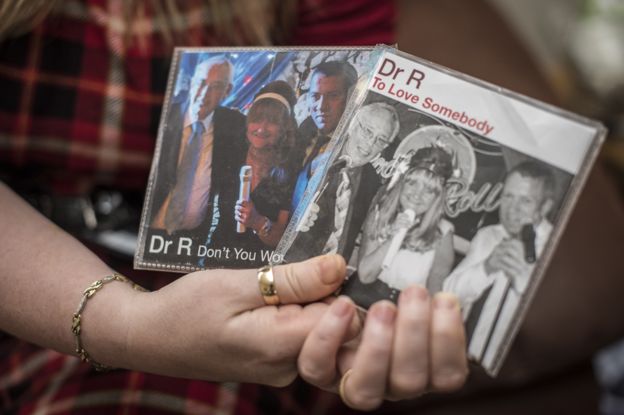
As a keen amateur singer, Rachel would perform at the music nights, everything from Roberta Flack and Nina Simone to Boney M.
"The staff would get up dancing with the residents. You'd see smiles on their faces - it really was such a lovely thing to see."
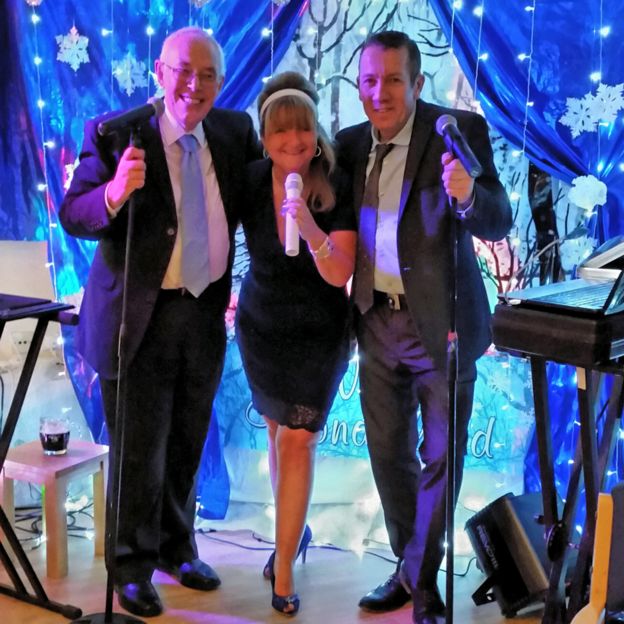
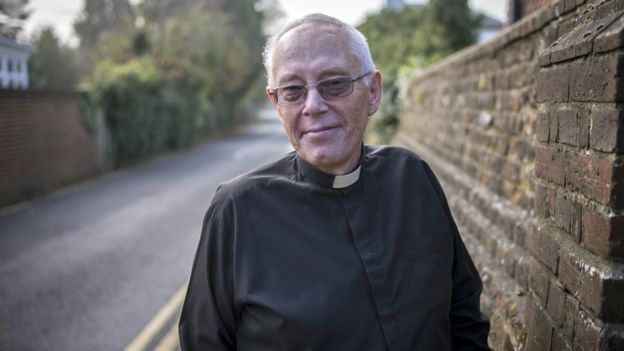
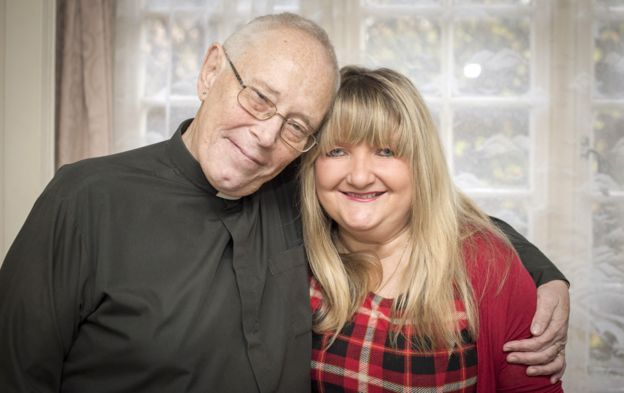
Image captionThe Reverend David Walford, Rachel Burns and singer Roy Matthews performing at Park Hall, Christmas 2014 (Photo: Rachel Burns)
One Friday Rachel returned home after music night and decided to share some of the special moments from the evening online.
"I was quite elated at how the night had gone," Rachel says. "I posted the picture thinking that it would just be seen by a few people, mainly staff, on Facebook."
But two months later Rachel got a phone call summoning her to head office.
"As soon as I got there, when I saw their faces, I knew I was in big trouble."
Rachel had done four things wrong. She'd posted the photo on Facebook, she'd identified a Park Hall resident in the photo - a man with Down's syndrome who, eager to be photographed, had jumped into the shot beside her - she had also posted a video of the music night, and she was Facebook friends with a relative of one of the residents.
From the word go, Rachel held her hands up and admitted all the council's allegations but nonetheless wanted to appeal against their decision.
"I know I shouldn't have put that picture up there, but should I really have had my career of 21 years taken away for one mistake? I wanted justice because I didn't believe what they had done to me was fair."
Find out more
Rachel told her story to Laurence Grissell on Radio 4's The Untold
Rachel lost her appeal and was given just two days to decide whether she would accept demotion - with a significant pay cut - or face dismissal. She asked for extra time to consider her options, but the council refused. Instead, Rachel, who by now had been signed off with stress and anxiety, received a telephone call demanding that she come to a decision immediately.
"I said, 'I'm off work sick, my doctor doesn't feel I can make such a life-changing decision at the moment.'"
But Rachel was told if she didn't accept the demotion she would be dismissed from her £45,000 a year job, with immediate effect.
"I got a letter the next day which said, 'I'm sorry you have decided to accept dismissal.' And that was it."
Claire Pooley's brother is the Park Hall resident in the photo that Rachel posted on Facebook.
Claire says her brother loves to be the centre of attention and loves to share photographs of himself with the rest of his family. The Friday music nights were the highlight of his week.
"He loves singing and dancing," Claire says, "Rachel and the guys allowed him to just blossom on a Friday evening.
"The moment we walked in the door we knew Park Hall was a special place," Claire's husband Graham continues. "The atmosphere, the culture and the behaviour - people were happy there and had a lot of stimulation."
The couple say that the Park Hall staff always encouraged Claire's brother to get up and sing at the music nights.
"He would practise and get ready for it - although he sang the same three songs every week," Graham says. "We loved watching him - it brought him alive, it was wonderful."
Neither Claire nor Graham feel that Rachel should have been fired for posting the photo of Claire's brother.
"None of us had a problem with it - gross misconduct or not," Claire says.
"After 21 years is it appropriate to sack the manageress who's created a culture and environment at this special home in the way that they have?" asks Graham. "The answer is no, it's not."
It's autumn 2016 and Rachel has decided to take Surrey County Council to an employment tribunal for unfair dismissal.
"They have to understand that this is my life that we're talking about here," she says.
"I want my career back."
A preliminary hearing date is set for early November.
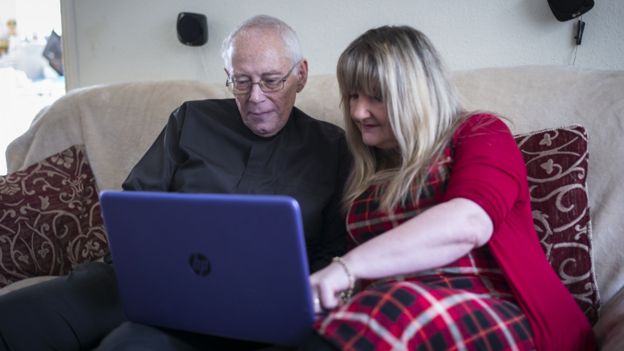
But she can't afford any formal legal representation and so is planning to face the council's barristers with only the help of her close friend, the Reverend David Walford, a retired healthcare chaplain who's never done anything like this before and admits he's out of his comfort zone.
"I'm very happy to stand up in front of people," David says. "What I'm not sure of is facing people who have had a lifetime's career in legal work."
David was at Park Hall on the evening that the photo was taken. Like Rachel, he's a singer and would perform at the Friday night music shows.
"I've seen a lot of care homes in my time as a parish clergyman and as a hospital chaplain. I knew the difference between what I'd usually see and Park Hall. Care with love, not care out of duty - that's what Rachel was giving. The thought that Rachel was being taken out of that actually brought me to tears."
To make matters worse, Rachel's husband Gary is very unwell.
"He's had the brain tumour for four years," Rachel says. "He was very healthy, but he walks with a stick now."
Not only is Gary unable to work, but without a reference Rachel can't find a new job. She and Gary are racking up huge debts living off their credit cards, but she hopes her money worries will be sorted out once the case is resolved, with any luck out of court.
Two weeks before the date of the preliminary hearing Rachel is doing an unpaid gig at a local pub. She's on stage singing Stuck In The Middle With You by Stealers Wheel and urging the punters to get up on the dance floor.
"It's just so much stress, it's crazy," Rachel says later, "which is why nights like this are brilliant, just to let off some steam."
Image captionThroughout the trial, Rachel kept performing
The day of the preliminary hearing in Croydon arrives. Rachel, who always believed the case would be settled out of court, says she never thought in a million years it would come to this. She's nervous.
"I've got to stand up against one of Surrey's senior solicitors to defend myself when I made one mistake in a 21-year career. They have crucified me."
The judge sets a date for a full hearing, but it's seven months away, at the start of June.
Then, out of the blue, towards the end of December, Rachel receives a settlement offer from the council. For a couple of days, she considers accepting the £7,500, before having a change of heart.
"It was a joke, an absolute joke," Rachel says. "And it's not even about money now, it's about showing them for what they are."
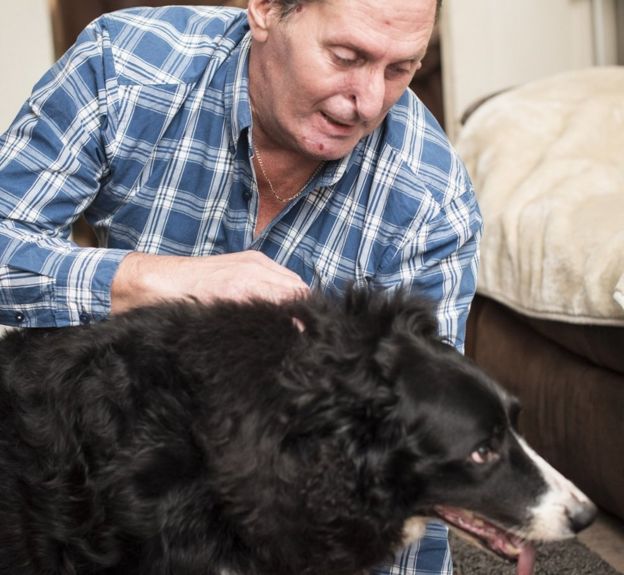
With the case dragging on, Rachel is really feeling the strain. She is anxious and depressed. So much is at stake - by now, she and Gary are in dire straits. Their debts are mounting, and they're seven months in arrears with the rent on the house in Reigate that they share with their border collie, Bramble.
Image captionRachel's husband Gary and their dog, Bramble
"We are scraping pennies, literally pennies," she says. "It's never-ending, it never goes away.
"All I did was put up a picture of a client enjoying their life in the care home that I loved working in," she says, beginning to cry.
By June 2017 the couple are at breaking point. They have no money in the bank and no savings to fall back on. Rachel is fearful that they're going to lose everything, including the roof over their heads.
"It just goes to show that when you think you have everything it can be snatched away from you just like that, for one mistake," she says.
The trial is taking its toll on David, too. He's exhausted. "This case has just become monstrous," he says.
Two days before the tribunal is due to start Rachel decides that she's packing it in, she can't go on. Her husband Gary pleads with her for almost three hours not to walk away now. This isn't the first time Rachel's doubted the wisdom of continuing with the case.
"This case has destroyed her," Gary explains. "She has no confidence any more, she doesn't sleep any more, we argue much more now. It's been disastrous.
"I've had to watch my wife slowly falling apart, because of what they've done to her."
Finally, in early June, in a rundown corner of West Croydon, Rachel's employment tribunal gets under way. She has given evidence and a number of witnesses have spoken and been questioned. But two days into the proceedings the judge has to adjourn the hearing when Rachel becomes very distressed.
"It just got too much," she says. "I thought, 'You've broken me to the point where I don't have the self-esteem at the moment to go back into management.' And it's such a shame. I said I was sorry, I told the judges the absolute truth."
The case finally concludes but without any decision. Rachel will have to wait another seven weeks for an answer.
Image captionThe Rev David Walford agreed to help Rachel Burns with her defence
It's the beginning of August 2017, nearly 20 months since Rachel was first suspended from her job, and she has some exciting news.
"I won! Oh, my God, I won!"
The court has upheld her claim of unfair dismissal.
The judge decides that Surrey County Council's decision to demote Rachel was within the band of reasonable responses, given that she'd admitted the allegations against her.
But she concludes that the timescale the council gave Rachel to decide whether she would accept redeployment or face dismissal - just two working days - wasn't long enough. This procedural aspect, she says, was a fundamental flaw.
"Justice has prevailed!" Rachel says. "It's amazing that if you believe in something and you know your worth you just keep going. You keep going, and going and going."
But Rachel will have to return to the employment tribunal on 13 November for a remedy hearing at which the court will decide how much she should be given in compensation. She has no idea how much that's likely to be but fears that the sum will be reduced because she admitted the allegations against her.
She and Gary now have debts to the tune of about £50,000 and are 14 months in arrears with their rent, and although Rachel now has a reference from Surrey County Council, it states that she was fired for serious misconduct, so the prospect of her finding work is still uncertain.
"As a manager myself I wouldn't look very favourably on that candidate," she says.
Despite the win, going back to work will be a struggle. Before losing her job two years ago, Rachel had been signed off with stress, and she still suffers from anxiety and depression.
Meanwhile the job she loved has gone forever. Park Hall closed its doors on 30 June as part of Surrey County Council's plans to shut down all six care homes it owned and ran. The residents were rehomed.
"I really loved Park Hall," Rachel says. "It was like a family to me more than going to work."
Image capti
Why I chose to donate my eggs
Why would anyone donate their eggs to help a stranger have a child? Elaine Chong explains her reasons.
I first heard about egg donation when I was at university in the US. We studied the sociology, psychology and biology of sperm and egg donation, and I was really inspired by the gift-giving nature of it nted young, healthy women who were well-educated, but that there was a real shortage of women of colour.
I thought about people like me - from a Chinese background - who might have fertility problems and want to have children really badly. I thought about my gay male friends who spoke at length about wanting to be good parents and how my gift could help them, too.
The professor talked about how each egg could be worth up to $3,000 (£2,280) which made the lecture hall go: "Ooooooh!"
I decided to give it a go and registered via a website decorated with pictures of cheerful, chubby babies.
Image copyright
Unfortunately, I failed the screening process almost immediately - anyone who lived in the UK for more than six months from 1980 to 1997 is ineligible because of the possible risk of transmitting the human form of BSE (vCJD). This also meant I couldn't donate blood, or be put on the organ donor list.
But the idea stayed with me, and when I came back to the UK for my postgraduate degree, I decided to try again here.
One big difference is that donors here receive a one-off compensation fee of £750 ($990) to cover costs - but I wasn't doing it for the money
I registered through another website decorated with cute baby pictures and was invited to take part in a rigorous screening process.
They asked me lots of questions - the administrator, the nurse, the doctor - everyone wanted to know why I wanted to donate my eggs.
I boiled it down to: "I want to make families feel complete."
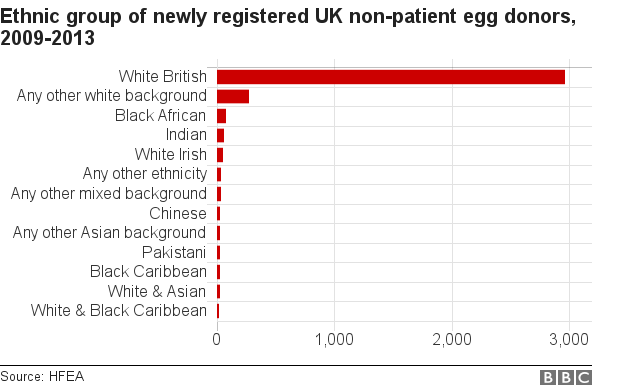
I found out that in the UK there is also a shortage of donors from ethnic minorities.
As far as I know, there's nothing in Chinese culture that prohibits egg or gamete donation, but it still took me ages to tell my mother that I wanted to do it.
My mum has always insisted that if she were to die, she wanted to donate any organ that could be useful to people. Eggs though! That's a bit different, because people would be walking around with our genes. Would my parents think of them as their grandchildren?
When I eventually told her, her immediate reaction was, "Let's not tell your dad."
When I was approved as a donor, they explained that it wasn't like in the movies and that after the donation I really wouldn't get any news about possible offspring until they were adults - and then only if they asked the Human Fertilisation and Embryology Authority for information about their egg donor.
I thought that seemed reasonable.
I found myself thinking a lot about how I was presenting myself to the potential parents. On the forms I filled in my height, my weight, my eye colour and medical history, but that doesn't really capture me as a person.
How would parents know if their kid might turn out to be sporty, fond of Thai food, kind to animals or like wearing black?
The clinic did ask about my hobbies and whether I played a musical instrument, but it felt like I was writing a pretty dry CV, to be honest.
Over the next few weeks I had lots of medical tests. I really hate having blood drawn so I always treated myself to a samosa afterwards - as a consequence, samosas now taste like cheering myself up.
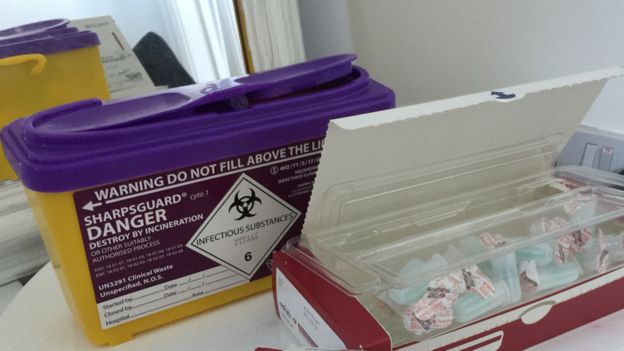
I had to inject myself with hormones twice a day, which was a bit like playing doctor. I kept the needles in our family fridge - nobody asked me what was in the strange-looking pack.
The syringe worried my mother though, so she had to leave the room while I did it.
Being on hormones was like having premenstrual syndrome, but 100 times worse - I was told that women "experience cramps" but I promise you, there was a lot more going on. I put on weight, I felt bloated. Jeans? Forget it - elasticated waists all the way.
I got tearful easily over anything - pop songs, animal videos. The visits took up a lot of time, the appointments themselves were short but there were a lot of them - luckily I was only working part-time, and mostly in the evenings. The overall process took over three months.
When I was close to donation - or "extraction", as it is sometimes known - I got a text from a nurse in the middle of the night.
A terrorist attack had happened that evening near the clinic, and the entire area was taped off as a crime scene. None of the staff could get to work and the more urgent patients had to be diverted to a Harley Street clinic. I only had a few days to go, so they needed to rearrange my appointment as soon as possible.
Image copyrightOn the way to the clinic the next morning, I found myself thinking: "If I'm killed in a terrorist attack, can it please be after I donate, because I've got these precious eggs in my tummy that need to go to families who are relying on me."
The importance of what I was doing hadn't quite sunk in until that moment.
The Harley Street clinic was so plush that the waiting room had a mural. The magazines were proper fashion magazines and instead of having to crane my neck to look at the ultrasound, I could see it on a huge plasma screen on the wall.
The technician counted my egg sacs. I'd got pretty good at counting them myself over the weeks. They decided I was ready and told me about the donation procedure, which involved fasting the night before.
I had to come back early the next morning. I decided to dress up for the occasion because I didn't want to feel like a patient - plus, it was Harley Street!
I was put in a waiting room and through the curtains I could hear a steady stream of women who were also there to donate. I couldn't see them, but when I heard someone refer to me as "the Chinese lady" I assumed the others weren't.
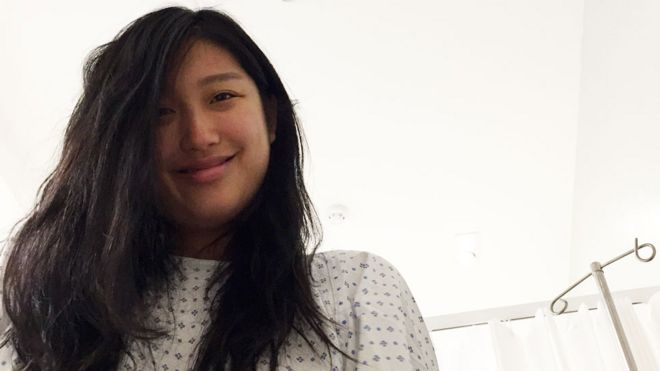
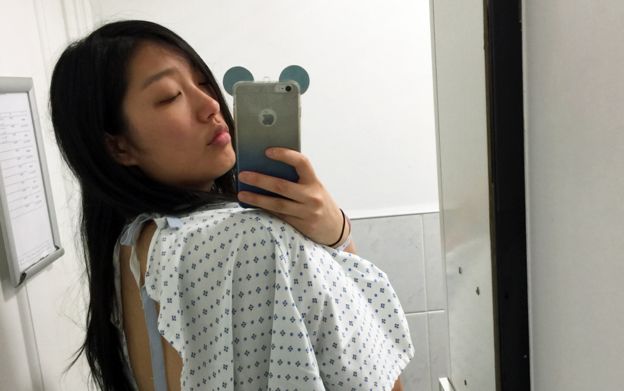
I'd never been put under a general anaesthetic before, or even worn a hospital gown. The nurses were concerned for my modesty but I was taking selfies in the bathroom pretending it was a backless dress.
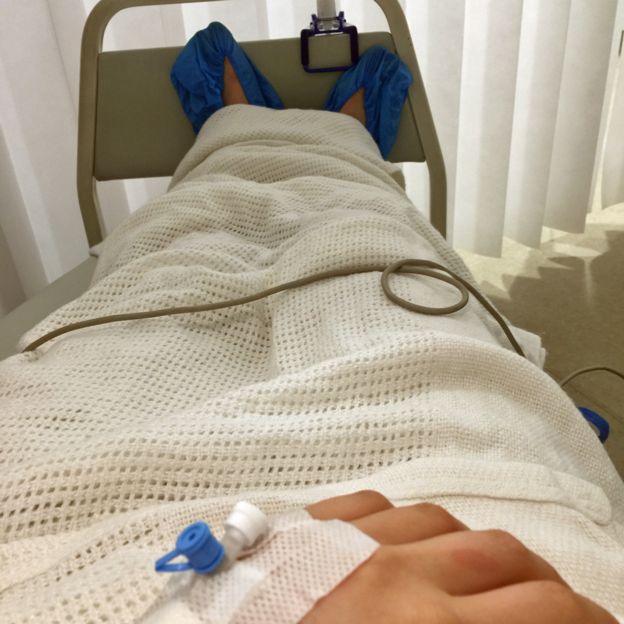
Going into the theatre I put my legs in the stirrups and tried to peer around the operating theatre - I wanted to remember everything, but they counted me out and the next thing I knew, I was in a chair in the recovery room. The surgery had taken 15 minutes.
I was quite drowsy, and slept on and off. A nurse came to ask if I wanted a biscuit - even in my half-conscious state I was a diva and asked her to bring me a selection.
I got a box of chocolates and a "Thank you for donating" card.
They told me they had taken 11 eggs in total - one short of a dozen. It would be cool if even one became a person.
I was told to write a goodwill letter to the parents and potential offspring. It would be the only thing they got from the donor until any children were old enough to decide whether or not they wanted to contact me.
I wrote a letter on my phone, as soon as I left the clinic. I suddenly got so emotional about all these hypothetical kids that I started to cry.
I told them that they were the result of much planning and love, and that my family, my partner, my friends all cared about them - even though they don't know them.
I also told them a bit more about me - about my passion for social justice and that I don't suffer fools gladly.
I hope that in about 18 years' time I'll find out how it went.
Would I do it again? Maybe. I do think I made the right decision and it wasn't as difficult as I had imagined.
T
he lynx effect: search for one-year-old Lillith continues in west Wales
Zoo keepers kitted out with thermal imaging equipment, nets and cages baited with rabbit have been scouring a craggy hillside and the gardens of a seaside town in search of a wild cat that made a daring leap for freedom.
Lillith the Eurasian lynx is thought to have climbed a spindly sapling growing in the pen she shared with her mother and two siblings and dived over a 4-metre fence and two electrified wires, possibly as she chased a bird.
The year-old lynx – around twice the size of a domestic cat – has eluded the efforts of staff at the Borth Wild Animal Kingdom in west Wales and those of Dyfed-Powys police, who provided a helicopter to recapture her.
“We’re pretty sure we know roughly where she is,” said Dean Tweedy, who runs the small coastal zoo with wife, Tracy. “It’s a matter of tempting her back. It’s a waiting game. She’s never hunted for herself or ate live food so she’ll soon get hungry if she can’t catch rabbits or rodents.”
The zoo insists that despite her sharp teeth and claws and her adventurous spirit, Lillith does not pose a danger to either the public or livestock. “That hasn’t stopped some of the local farmers saying they’ll shoot her if they see her worrying sheep,” said Tweedy. “The sooner we get her back safe and sound the better.”
The young lynx was last seen in her enclosure on Thursday. At first staff thought Lillith may have clashed with her mother, Dee, and was lying low in her house.
On Sunday morning, Dean and Tracy Tweedy donned protective clothing and went in to check on Lillith only to find she had vanished. They called the police, who scrambled a helicopter and warned the public not to approach the cat.
As darkness fell on Sunday the helicopter’s thermal imaging equipment spotted something among the gorse on a crag outside the zoo just a few hundred metres from the main entrance. A keeper caught a glimpse of Lillith at 1am on Monday but could not get to her.
There have been other sightings further afield, including a Borth householder who phoned the zoo to say the cat was in her garden. Keepers hurried over only to find it was a sheep.
Later keepers patrolled the seafront, using a cafe balcony as a vantage point to scan gardens and the railway line in case Lillith had strayed from the hillside where she was spotted.
“It’s stressful,” said keeper Charlotte Foster. “I know she won’t hurt anyone. The worry is that she will get hurt in some way. I’m fearful a farmer may take a shot at her if she breaks cover.”
The zoo took the precaution of cancelling its half term Halloween “spooky night tours” on the basis that it was not a great idea to have children running around in the dark when a wild cat was at large.
But the attraction, which the Tweedys took over five months ago, remained open on Monday and drew in large crowds, some visitors keen to get a glimpse of a wild animal actually in the wild.
“It does add a certain frisson to think that there is a lynx on the loose around here,” said Jim Elliot, who had brought his grandson to the zoo. “I’m sure we’re perfectly safe.”
Lillith’s mother was prowling around the cage, looking put out and said to be “unsettled”, while her two siblings cried out for her from time to time.
Despite the optimism of the zoo, it is possible that the hunt may take longer than the keepers hope. Last year a lynx called Flaviu spent three weeks on the run after escaping from the Dartmoor Zoological Park in Devon.
The last of the British lynx died out about 1,300 years ago through habitat loss and persecution. A group of conservationists called the Lynx UK Trust is arguing that the forest-dweller should be reintroduced.
The trust describes lynx as solitary and secretive and says they present no threat to humans. It adds that it is exceptionally rare for them to predate on agricultural animals.
Paul O’Donoghue, the trust’s chief scientific adviser, said: “I feel very sorry for this lynx. It must be terrified.
“The lynx is called the ghost cat because people don’t know it’s there – it is very elusive.
“You have more chance of winning the EuroMillions than being attacked by a wild lynx – in fact you have more chance of winning it two weeks in a row.”
O’Donoghue said the group had previously received interest from landowners in mid Wales to allow lynx to roam on their land.
But Wyn Evans, chair of the National Farmers Union Cymru livestock board, said its members were concerned both at the loss of Lillith and the idea of lynx being encouraged back. “NFU Cymru firmly maintains that these animals should only be kept in safe and secure environments where they cannot risk harm to livestock,” he said.
There is already talk in these parts of a “Beast of Borth” that has prowled for more than a decade. The rumour is that someone released a pet puma into the wild.
“A farmer lost 12 sheep and they blamed it on the puma,” said Dean Tweedy. “It’s probably just a story but we want to get Lillith back before she becomes another local legend.”







0 comments:
Post a Comment